
New Year, New Relationships
Each New Year I focus my energy to a single task in my business. As a multi-service entrepreneur, it is easy to put too many to-dos on my plate, so instead, I try to focus on one over-arching task each season

New Year, New Relationships
Each New Year I focus my energy to a single task in my business. As a multi-service entrepreneur, it is easy to put too many to-dos on my plate, so instead, I try to focus on one over-arching task each season.
Last year it was ‘learn how to raise cattle in 18 months versus 24 months’ and ‘grow my online portfolio’ in weddings.
At the end of last year, I’d completed both of these tasks but I felt more alone than ever. Now, I’m an introvert through and through, but this sense of being alone was deep, deeper than I ever thought and ever let myself recognize.
So, per usual I sat down at the end of the year, reconciled my books, looked through the data I’d collected on both the farm and weddings I’d designed for and said, ‘what’s next’. (ps. I love these ‘mundane’ tasks and usually find myself caught up in them). This year it wasn’t a black and white task that came to the forefront of my mind. It was this ‘feeling’ (which I’m not always good at recognizing) in place of a ‘learn this’ or ‘achieve this’ task.
It was the desire to form meaningful relationships.
Sure, it is easy to preach ‘know your farmer’ but I started to question what steps I’d actually taken to know people in my community. What steps had I taken to know the people who trust and buy from me? What did my stance on ‘know your farmer’ actually means to me, this introverted farmer who loves animals and gets anxious in crowds? I have fear, I lack confidence and ultimately it’s been what’s kept me from truly living what I so desperately wanted for my customers. For them to know me, their farmer.
The same became so drastically apparent in my wedding design as well. I’ve met vendors, had coffee with vendors and made some friends in the industry. I’ve serviced my brides, openly communicated with them and had a very happy experience with each of them over the course of the year. But, these people that I’ve met, had coffee with and serviced always seemed to be an arms distance away. Not because I’ve purposefully decided to keep a distance, but instead I chose to lean into what comes naturally to me as an introvert. But, ultimately as a person, I need relationships with more meaning.
I now see how vital relationships are for every person. Every introvert, every extrovert, every entrepreneur, every mother, father, sibling, and the list goes on. We all crave more meaningful relationships in our lives. I think it has become more apparent to me as an entrepreneur because so much of ‘marketing’ and ‘running a business’ seems to be done on the other side of a screen.
And while all that ‘screen time’ is necessary it’s time to practice what I preach and form relationships with you, with my readers, with my customers and clients and those who receive my weekly emails.
So, that is what 2020 is going to look like for me and this business. I’m focused on getting out of my comfort zone, getting to know all the special people that surround me and welcoming you into the pretty and not so pretty parts of running a farm and floral business. I hope to get to know you better and share more of myself with you this decade.
I’d love to meet you, and I’d like to formally welcome you to join me at an event this season. Let’s get to know each other better.

Farm | Renovating Sheep Pastures
How we’re renovating our sheep pastures - from overgrown to lush and nutritious
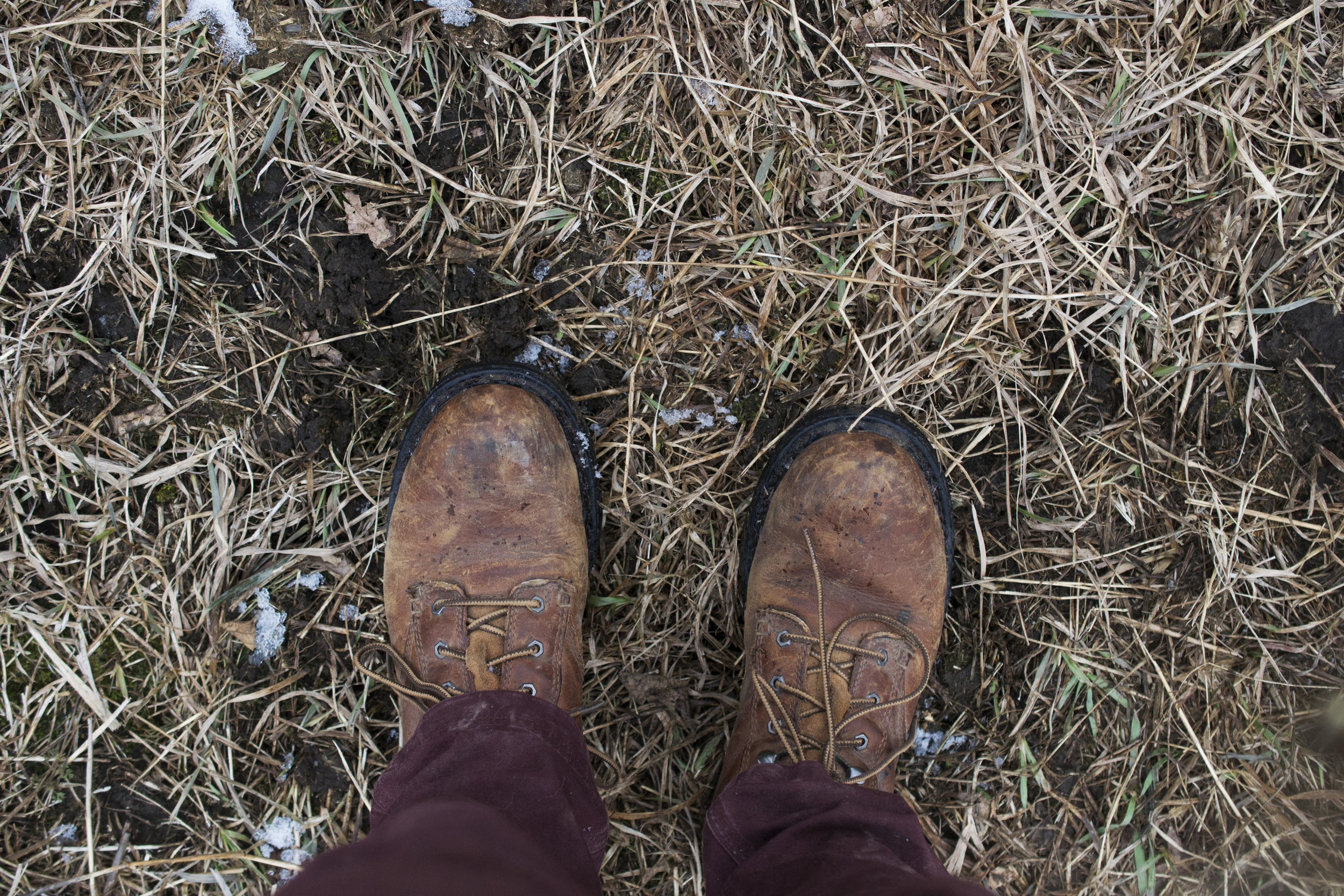
Renovating Our Sheep Pastures
This is a lengthy post… about nerdy stuff like grass and soil. I love documenting and this post is certainly a compilation of lots of documentation. So, if you like soil, grass and learning about how other farmer’s make decisions, this post might just be your cup of tea.
what we started with
Our sheep pasture consists of seven acres, three of which are significantly sloped and heavily wooded. Two acres was an existing alfalfa and orchardgrass field with two acres that is mostly brome grass.
using web soil survey
I looked at what we have for soil and slopes in our pasture. You can find your soil map HERE
72% of our pasture is | Newglarus-Dunbarton silt loams, 12 to 20 percent slopes, moderately eroded
17% of our pasture is | Elkmound-Northfield complex, 30 to 60 percent slopes, very rocky
11% of our pasture is | Eleva sandy loam, 12 to 20 percent slopes, eroded
What we did in 2018
In spring 2018 we cleared about 2 acres of brush which included prickly ash, grey dogwood, sumac, plum, boxelder and mulberry. I over-seeded the ‘thicket’ areas with a mix of grasses and legumes, of which 30% was legume. Over the summer months I focused on keeping the woody species from coming back in, using mowing and herbicides. In the fall I heavily grazed a 1/2 acre area of brome grass and over-seeded with the following over-the-counter mix:
50% Gulf Annual Ryegrass
27% Intermediate Ryegrass
19% Orchardgrass
3% White Clover
1% Medium Red Clover
In October I took our cattle through a two acre area that was primarily brome grass and had them beat it up to expose soil.
what we did in spring 2019
In spring 2019 we worked on clearing additional brush in the most heavily sloped areas. These areas have significant timber including walnut, catalpa and cherry. We removed mulberry, elm, cedar, boxelder along with honeysuckle, grey dogwood and plum (plum is poisonous to sheep). This area still has significant cover and will need additional clearing, maybe next year.
In the late winter spring months I developed my knowledge on sheep pasture mixes, mixes that maximize gains, and our options for our drought-prone slopes. With my research I developed the following pasture mix.
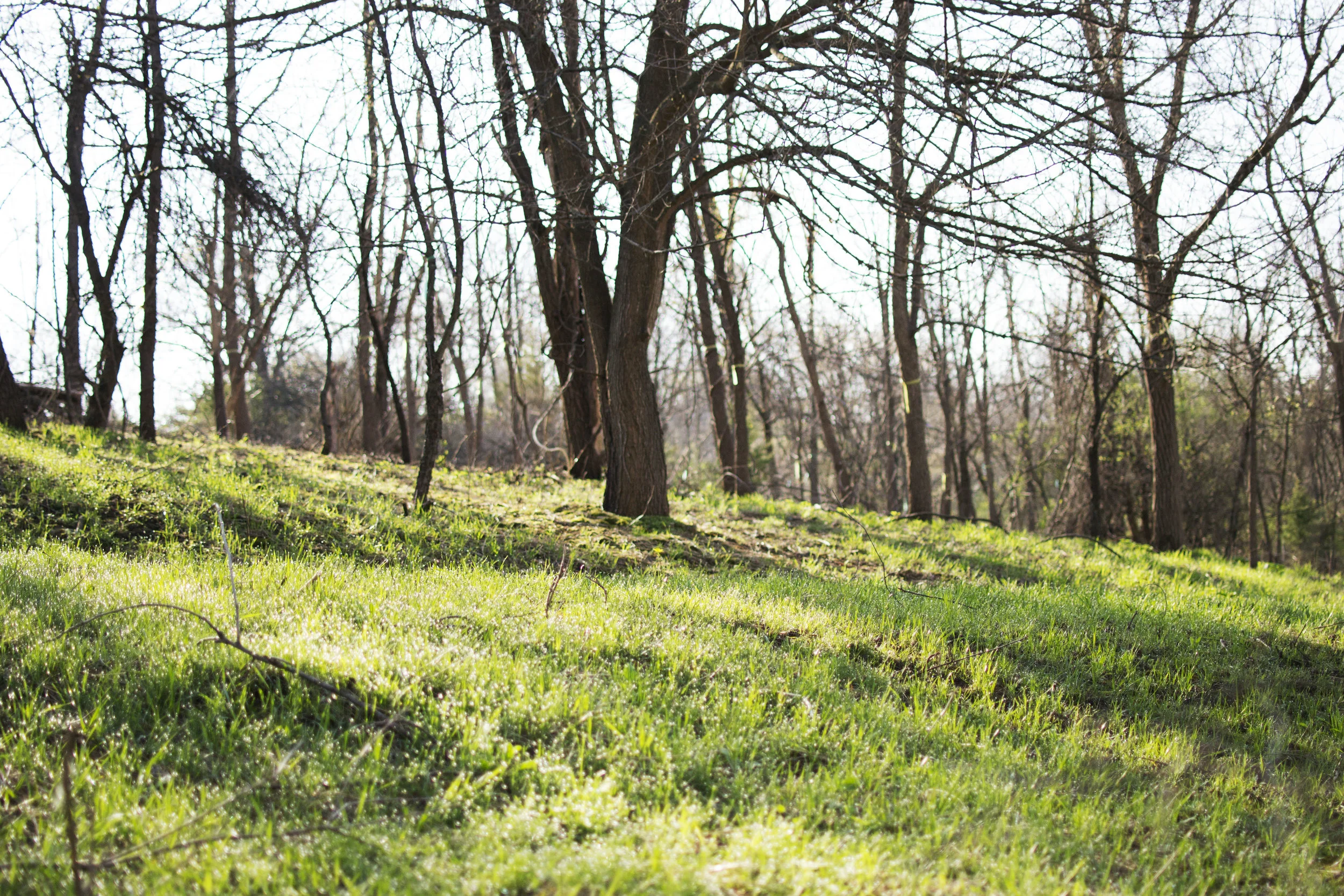
Our pasture mix
Chicory - 40%
Ladino Clover - 15%
Alice White Clover - 15%
Alfalfa - 5%
Orchardgrass - 10%
Festolium - 15%
My research lead me to develop a mix with a high chicory content. Chicory is non-bloating, and local farm research showed significant gains on chicory based pastures. I also realized during my research that sheep prefer legumes over grasses, so I made sure to develop a mix that put more focus on the legumes than the grasses. Chicory, alfalfa and the grasses show better drought tolerance than the clovers; however, I wanted to try and get some clovers established on the less sloped areas that will get more water. I’m curious to see what my results are after this growing season.
our alfalfa and brome areas
The bromegrass areas I over-seeded with a Ladino and Alice White Clover mix. Over the coming years I anticipate continuing to replace alfalfa with clover, chicory and other legumes, and diversify the brome acerage with additional legumes and chicory.
Planting on slopes
Since three acres of our sheep pasture are in-accessible with a tractor, I broadcast seed by hand and put sheep hooves on it for a day, right before a good rainfall. This three acre pasture was broadcast with the chicory blend.
how i’ll manage grazing this year
I will be managing weeds and woody plants this season by rotationally grazing both the sheep pasture and the brome area. Sheep are fantastic gardeners and I can’t wait to see the progress made by using them for management this season.
What we did in 2021
This spring we finally hired a company to come and finish removing invasive species including Mulberry, Boxelder, Grey dogwood, Sumac and others. These removals exposed additional acreage and opened up the canopy allowing light to infiltrate. I seeded the newly open areas with a mix of meadow fescue and orchardgrass. I also fertilized most of the average after putting a heavy coat of manure over the land last fall. This season we will lightly graze it to allow for it to establish, control weeds and allow the land to come to life.
video documentation - 2018 fall pasture walks
Video has already been a great resource for me as I develop the grazing systems at our farm. It provides a really great reference to what was happening the following season, challenges and what I was looking at doing in the coming year. It is insightful to what I thought my plan was last season, to what I actually implemented this season. Video has proven to be a quick and effective way to manage our grazing here at the farm.
I look forward to documenting our pasture progress again this fall.
video documentation - June 2019 update

Farm | No, Lamb Meat is Not From Baby Lambs
I get this question a lot actually, and I can’t believe I didn’t think to answer this question here on the blog before…

No, Lamb Meat is Not From Baby Lambs
I get this question a lot actually, and I can’t believe I didn’t think to answer this question here on the blog before…
So, I’m catching up and answering this question today
‘is lamb meat baby lambs?!’
Heavens no, that would be a sad world if we harvested baby lambs. They are so stinkin’ cute!
So what is ‘lamb’ meat?
Lamb meat is simply meat harvested before a year of age. Our wethers (ram lambs that have been castrated) are mature at 8-12 months. This season they were harvested at 10 months of age if they were singles, and 12 months of age if they were twins. Lambs at this size are fully mature (they grow like weeds) and would get less tender at an older age.
Then there is mutton
Mutton is the official term for lamb harvested after a year of age. Most often this meat is harvested from old breeding stock that is no longer in their prime breeding age. These animals are harvested and we’ll use the meat to make a tasty mutton grind, we don’t believe in letting any life go to waste.
Eat with confidence
I’m sorry it took me this long to ‘clear the air’ on this one. If you have any additional questions on your lamb be sure to ask!